
Planning & installation

Access decides more than budget.

Two things decide whether a pod can go in: the planning rules, and room for the crane. In England, a pod that sits in your garden as a caravan, used as part of your household, normally needs no planning permission. A separate home, a let or a business does, and we make the application.

Try your garden
01 / 09The rules
01 · The rules

A caravan in the garden

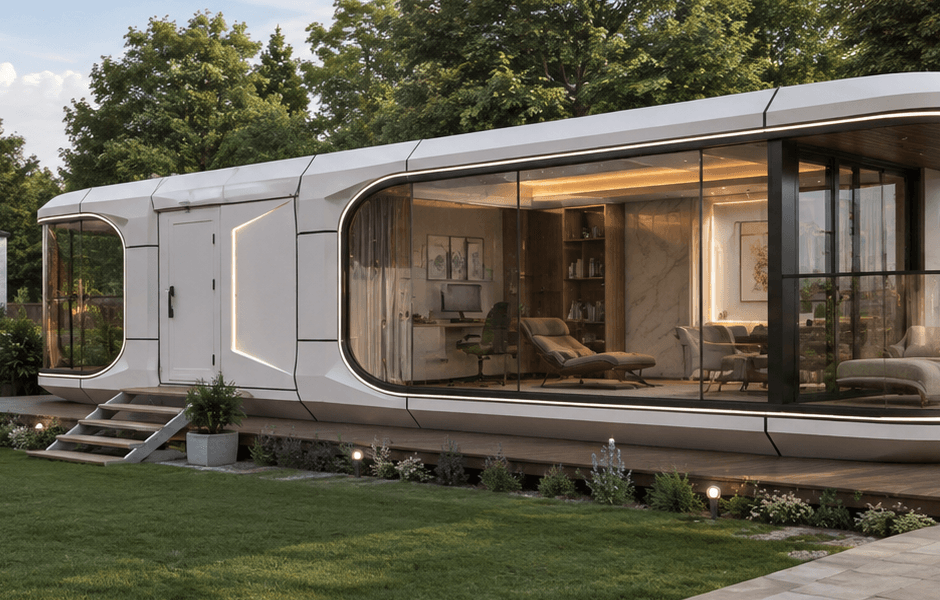
Our pods are lifted in by crane in one piece, and sit on a base without being fixed down. That can make them caravans in law.

In England, putting a caravan in your garden for your household to use isn't development, so it needs no planning permission. It's the rule that lets you keep a static caravan in the garden.

Here is what decides it, a step at a time. Scotland, Wales and Northern Ireland have rules of their own.

TCPA 1990 s.55 · Caravan Sites and Control of Development Act 1960 s.29
02 · Is it a caravan?

Moved whole, and not too big

In law a caravan is anything made to live in that can be moved whole, towed or carried on a lorry, wheels or not. Two halves bolted together on site count, if they then move as one.

Two halves can be up to 20 m long, 6.8 m wide and 3.05 m high inside. One piece has no set limit, but size counts towards being a building.

Ours are within those: 11.5 m long at most, 3.3 m wide, 2.6 m inside.

CSCDA 1960 s.29(1) · Caravan Sites Act 1968 s.13, as amended (SI 2006/2374)
03 · Not fixed down

Resting on its base

Each pod is built to be lifted whole, and rests on its base under its own weight. Nothing bolts it down.

Fix it to a foundation, or build a deck, porch or steps onto it, and it can become a building instead. Keep those free-standing.

If a crane can lift it in, it can lift it out again the same way. At the survey we confirm that for your garden, and that its services disconnect.

CSCDA 1960 s.29(1) · Carter v SSE [1994] · Barvis v SSE (1971)
04 · Where

In the garden of your house

The rule covers the land that goes with the house, its curtilage: the garden at the back, the front or the side.

A field or paddock beyond the garden isn't part of it. Putting a caravan there to use is a change of use, and needs planning permission.

TCPA 1990 s.55(2)(d)
05 · What it's for

Part of the household

An office, studio, gym or playroom, used by the people who live in the house, is part of how they use their garden. That isn't a change of use, so it isn't development.

Sleeping in it can be too: a guest room, or an annexe for family who share the house's kitchen, garden and bills.

Councils decide this on the facts. A Lawful Development Certificate from the council makes it certain, and answers anyone who asks later.

TCPA 1990 s.55(1), s.55(2)(d) and s.192
06 · When it needs permission

A home of its own, a let or a business

Lived in as a separate home, apart from the household, it's a new dwelling. That's a change of use, and it needs planning permission, caravan or not.

So does letting it to paying guests or tenants, or a business with clients or staff. A caravan that is let needs a caravan site licence from the council as well.

Where permission is needed, we make the application for you.

TCPA 1990 s.55(1) · CSCDA 1960 s.1 and Sch.1
07 · If it's fixed down

Then it's a building, and Class E applies

Fixed down, a pod is a garden building, and Class E's limits decide it: 2.5 m tall within 2 m of a boundary, 3 m elsewhere (4 m with a dual-pitched roof), eaves 2.5 m, nothing in front of the house, buildings on half the land round it at most, and not slept in.

The H4 to H9, at 3.3 to 3.4 m, are over, so fixed down they need a householder application. The H1 to H3, at 2.45 m, are just under: fixed down, one can pass as an office or studio, as long as its base doesn't lift it over.

GPDO 2015 Sch.2 Pt.1 Class E
08 · Access

Room for the crane

The pod comes by lorry and is lifted in by crane, in one piece. The crane has to stand within 14 m of the base.

In this garden it stands in the lane at the back. From the road, over the house, it would be too far. Overhead wires and trees in the swing are checked at the survey.

14 m
From the crane to the centre of the base
3.6 m
Clear width along the route
4.2 m
Headroom on the approach
09 · In short

No permission for the household

Set down as a caravan and used as part of your household, a pod normally needs no planning permission. A Lawful Development Certificate makes that certain.

A separate home, a let or a business needs permission, and so can a pod fixed down as a building. We make the application for you.

Guidance only, not a planning determination.Try the rules on your own garden ↓
Try your garden

Your garden, your pod.

Choose a pod, say how it will sit and what it’s for. It runs the same tests as above: the caravan route first, then Class E if it’s fixed down. England’s rules only, and it does not look up your address: we do that before the survey.

Laying out the garden…
The pod

H7: 11.5 × 3.3 m, 38.0 m², 3.30 m tall outside, 2.5 m inside, capsule shell, with a balcony. As a caravan, the height that counts is the one inside, floor to ceiling.

How it sits
What it’s for
Your home

As a caravan, where it stands in your garden doesn’t change the answer. Fixed down, it’s a building, and the garden’s shape matters: choose that above to see Class E.

Protected land

Tick any that apply. Not sure? We check your address before the survey. They restrict development, which a caravan used by the household isn’t.

What the rules say

Normally no permission needed

As a caravan used as part of your household, it isn't development, so it normally needs no planning permission. The checks below settle it, and a Lawful Development Certificate puts it beyond doubt.

Worth checking

  • Moved in one piece, not fixed down

    A caravan has to be capable of being moved whole, towed or carried on a lorry; it needs no wheels. H7 is built to be lifted in one piece and rests on its base under its own weight. Keep it that way: a deck or steps beside it should stand free, not fixed to it. At the survey we confirm it can be lifted out again from where it will stand, and that its services disconnect without breaking anything.

    CSCDA 1960 s.29(1) · Carter v SSE [1994]

Good to know

  • Within the caravan size limits

    The law's size limits are for a caravan made in two halves: 20 m long, 6.8 m wide and 3.05 m high inside, floor to ceiling. One made in one piece has no set limit, but size counts towards whether it is a building, so these are the ones to keep within. H7 is 11.5 m by 3.3 m, 2.5 m high inside. The inside height is what counts, not the outside.

    CSCDA 1960 s.29(1) · Caravan Sites Act 1968 s.13(2) · SI 2006/2374
  • Part of the household

    An office, studio, gym or playroom used by the people who live in the house is part of how they use their garden. That isn't a change of use, so it isn't development. Working from it yourself counts; staff, or clients coming and going, may not.

    TCPA 1990 s.55(1), s.55(2)(d)
  • Get a Lawful Development Certificate

    Nothing has to be applied for, but a certificate from the council confirms in law that siting it and using it as described is lawful. It is decided on the facts and the law, not on planning merits such as looks, and it answers anyone who asks later, a buyer's solicitor included.

    TCPA 1990 s.192

Guidance only, not a planning determination.

These are England’s rules: the Town and Country Planning Act 1990, the caravan Acts of 1960 and 1968, and, for a building, Part 1, Class E of the General Permitted Development Order 2015. Scotland, Wales and Northern Ireland have their own.

Nothing you enter here leaves this page.

Install day

One day, hour by hour.

See the whole day in 3D →

The crane sets up first thing, the pod is lifted onto its base, and by the afternoon it is connected, tested and handed over.

Find out what your garden can take.

The survey is free and carries no obligation. You get a written access report and a groundworks quote whether or not you order with us.

Book a site visit

Guidance only, not a planning determination.

Pod on a prepared deck